

How to remove pet urine odour from fabric?
Effective ways to neutralise unpleasant odours and permanently remove carpet stains.
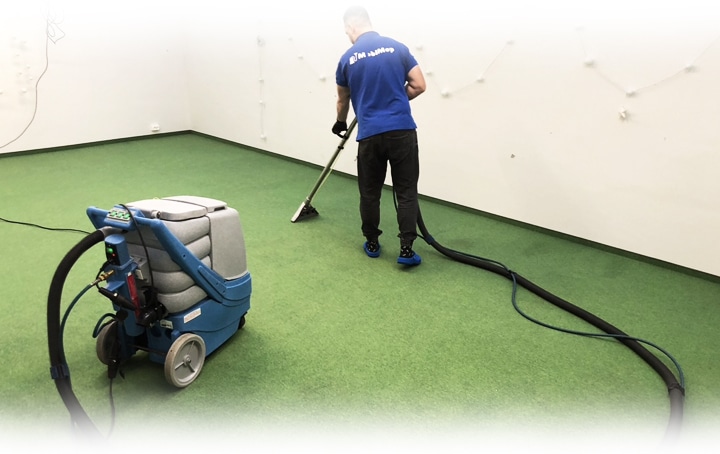
Pet urine is the one stain that can keep coming back for months, even after several cleans. The reason is chemical: water and detergent alone do not remove the compounds responsible for the smell. Below we explain why that happens, what to do about a fresh accident, how to deal with an old stain, and when enzyme products become essential.
Why the smell of urine keeps returning
Urine is not simply coloured water. Immediately after an accident it contains urea, creatinine, mineral salts and uric acid. The water and the urea evaporate or rinse away easily enough. Uric acid is the problem: its crystals do not dissolve in water and stay in the fabric after every ordinary wash.
On their own the crystals smell faintly. But as soon as moisture appears - a rainy day, a mopped floor, steam from the kitchen - they release the odour all over again. That is why the familiar story goes: "we cleaned it, the smell went, two weeks later it was back". It never left. It was there the whole time, waiting for humidity.
The second mechanism is bacterial. Bacteria break urea down into ammonia, which is where the sharp, stinging smell comes from a dozen or so hours after the accident. The warmer the room, the faster this happens.
A fresh accident - what to do in the first few minutes
A thick wad of paper towels and firm pressure - use your foot or your knee. Repeat several times with fresh towels. This stage decides everything: the less liquid remains, the fewer crystals will form.
Water spreads the urine over a larger area and pushes it deeper - into the foam of a sofa or the backing of a rug. The stain grows and the smell becomes harder to remove.
Enough to wet the whole soiled zone, including the edges you cannot see. The enzymes have to reach everywhere the urine reached.
Enzymes need anything from fifteen minutes to a few hours. Cover the spot with a damp towel so the product does not dry out too quickly - a dry enzyme stops working.
Use a dry towel, then a draught or a fan. Put nothing on the cleaned spot until it is completely dry.
Why enzymes specifically
Detergent dissolves grease and dirt but leaves uric acid untouched. Vinegar neutralises ammonia, so it brings brief relief and nothing more. Bicarbonate of soda absorbs odour from the air but not from the fibre. Enzymes work differently: they split the uric acid molecule into smaller, soluble fragments that rinse away with the water. It is the only route to a lasting result.
An old stain - how to find it and remove it
With an old smell the hardest part is working out exactly where the source is. Animals return to the same place, so there are often several stains while you can see one, or none at all.
How to find the source
- A UV lamp. Urine glows yellow-green under ultraviolet light. Turn off the lights and run the lamp over the upholstery, the rug and the skirting boards - you will see how far the stains extend, including the ones invisible in daylight.
- Touch. Old stains feel stiffer and rougher because the salts have crystallised inside the fibre.
- The smell near the floor. Ammonia is heavier than air, so it is strongest low down, right at the surface.
- The animal's behaviour. A cat or a dog goes back to exactly the spot where the scent remains, which is the surest sign that something is still there.
Working on an old stain
- Soften the area with a small amount of lukewarm water - the crystals have to rehydrate before the enzymes can reach them.
- Apply more enzyme cleaner than you would on a fresh stain; it has to penetrate to the full depth the urine reached.
- Cover with cling film or a damp towel and leave it for several hours, or overnight if the soiling is heavy.
- Blot, rinse with a little water, blot again.
- Dry with air moving through the room. Judge the result only once it is completely dry - damp fabric always smells stronger.
- Repeat the cycle if you need to. Old, repeated soiling rarely comes out on the first attempt.
What not to do
- Do not flood it with water. You enlarge the stain and drive the urine into the padding, where a towel can no longer draw it out.
- Do not use hot water or steam. Heat sets the proteins in urine and strengthens the smell.
- Do not mask the smell with air freshener. The odour comes back, and now with perfume on top of it.
- Do not combine an enzyme cleaner with vinegar or bleach. Enzymes die in strongly acidic and oxidising conditions - you are simply wasting the product.
- Do not hold a hairdryer close to it. Concentrated heat deforms the foam and sets the stain.
Urine on different surfaces
Sofa and armchair
The hardest case, because underneath the fabric there is foam that soaks up liquid like a sponge and gives it back very slowly. Home methods reach the fabric but not the filling. If the smell returns after enzymes, the source is in the foam, and you need extraction that draws the liquid out of the full thickness of the seat. We describe this under upholstery cleaning.
Mattress
Much like a sofa, except the absorbent layer is thicker. What matters is drawing the liquid out quickly and working with the product without soaking. There is more in our piece on looking after a mattress.
Rug
Urine passes through the pile into the backing and, if there was a lot of it, onto the floor beneath the rug as well. That is why a rug means checking three layers: the pile, the underside and the floor. Skip the floor and the smell will keep returning from a perfectly clean rug.
Fitted carpet
The most treacherous of all, because it is glued down and cannot be lifted. Urine spreads underneath over an area larger than the visible stain. Here extraction with an enzyme cleaner is almost always necessary.
Laminate and floorboards
If urine has got in between the boards, the smell will keep coming back no matter how many times you clean the rug above them. The joints need wiping with an enzyme cleaner, and if it has been sitting there a long time, be prepared to replace a few boards.
Why timing matters so much with urine
| When you react | What is happening | Chance of full removal |
|---|---|---|
| Within 15 minutes | The urine is still liquid, no crystals have formed | Very high |
| Within a few hours | Bacteria start breaking down urea, ammonia appears | High, with enzymes |
| After a day | Uric acid crystals bound to the fibre | Good, but the product needs longer to work |
| After weeks | Soiling in the filling and often in the subfloor | Usually only with extraction |
| Repeated accidents | Several layers of soiling of different ages | Several treatments needed |
How to stop the animal coming back
Removing the smell is half the job. The other half is changing the habit. An animal returns to where it can smell its own mark, so as long as the scent is detectable to them - and their sense of smell is dozens of times sharper than ours - the problem will keep repeating.
- Clean the spot with enzymes. This is the precondition; without it nothing else will work.
- Change what the spot is for: put a water bowl, a bed or a scratching post there. Animals do not relieve themselves where they eat and sleep.
- With a cat, check the litter tray - how clean it is, where it stands and how many there are. The rule of thumb is one tray per cat plus one spare.
- With a dog, go back to the puppy routine for a while: more frequent outings and a reward straight after they go outside.
- Rule out health causes. Sudden accidents in an animal that never had them before are a common sign of a urinary infection, so it is worth starting with the vet.
Cat versus dog - the differences that matter
Cat urine is more concentrated than a dog's because cats drink less water. That means more salts and more uric acid in the same volume of liquid, so a stronger smell and harder removal. On top of that comes marking: a cat sprays a small amount onto vertical surfaces - the side of the sofa, a curtain, a table leg. Those traces are easy to miss until you check with a UV lamp, and they are usually the ones responsible for a smell that seems to come from nowhere.
With a dog the problem is usually horizontal and larger in volume: one puddle on the rug or the carpet. There is more liquid, so it reaches the backing and the floor more often. Chemically, though, it is milder than a cat's and responds better to enzymes on the first pass.
The practical conclusion: with a cat, check vertical surfaces too and work slowly, in several passes. With a dog, focus on depth - what counts is how much liquid you can draw out of the layers underneath.
How to choose a product
On the shelf in a pet shop, products with completely different modes of action stand side by side, and the labels look much the same. A few pointers that help tell an effective cleaner from an air freshener:
- Look for the word "enzymatic" in the ingredients, not just in the marketing line. The ingredient list should mention enzymes, or the bacterial cultures that produce them.
- Avoid anything whose only action is fragrance. If the description talks solely about "neutralising odour" and "freshness", it is usually perfumed water.
- Check that the product contains no ammonia - for an animal that is an invitation to come back to the same place.
- Pay attention to the expiry date. Enzymes lose activity over time and after freezing, so a bottle bought as a spare two years ago may no longer do anything.
- Do not mix products. An enzyme cleaner applied over the residue of another stain remover loses its effectiveness. If you have already tried something else, rinse the spot with clean water first.
Store the product at room temperature, away from sunlight. Before using it, always test on a hidden section - the back of the backrest or under the seat - and judge the test once it has dried, not straight away.
When the smell fills the whole flat
If the smell is noticeable not just at the stain but throughout the room, it means one of three things: there are several stains, the urine has reached the filling of the furniture, or the source is somewhere you have not found yet - under the rug, behind the sofa, at the skirting board.
In that situation, start with diagnosis rather than cleaning. Go over the whole room with a UV lamp, including the walls up to about 40 cm - a cat's mark can easily be there. Note every spot, and only then plan the work. Cleaning one spot when there are five will not change anything you can notice, and it creates the impression that the product does not work.
It is also worth checking the things that are easy to forget: the animal's bed, the mat by the door, the bottom edge of the curtains and the underside of the furniture. Smells from those items often get wrongly blamed on the sofa.
When removing urine odour needs a professional
Home enzymes cope with a single fresh accident on fabric. Professional cleaning is needed when:
- the smell returns despite two or three attempts;
- accidents have happened repeatedly in the same place;
- the urine has reached sofa foam, the inside of a mattress, or the floor under a rug;
- the stain is bigger than your hand;
- the smell is noticeable throughout the room rather than only at the stain.
In our service we combine two stages: an enzyme product at a concentration not sold in retail, and extraction that rinses the broken-down compounds out of the full thickness of the material. Without that second part, the enzymes stay inside along with everything they have broken down. The whole treatment on a sofa usually takes about an hour, and the piece dries in four to six hours. You will find prices in our price list.
Frequently asked questions
Why does the smell come back when it rains?
Because uric acid crystals release their odour when the humidity of the air rises. It is the clearest proof that the source is still inside the material.
Does vinegar work on urine?
It neutralises ammonia, so the smell weakens for a while. It does not break down uric acid, though, so the problem returns. Vinegar also deactivates enzymes if you use it immediately before the product.
Is bicarbonate of soda enough?
It absorbs odour and moisture from the air but does not remove the source from the fibre. It works as a supplement after cleaning, not instead of it.
How many times does an old stain need treating?
For a single old accident, usually once. Where accidents have repeated in the same spot, two or three times, a few days apart.
Can a sofa a cat has used for a year be saved?
Often yes, but it takes several treatments and a check on whether the urine has reached the wooden frame. If it has, the smell will keep returning and replacing the filling is sometimes the only answer.
Will the smell disappear immediately after cleaning?
We always judge after it has dried completely. Damp material smells stronger, and the enzymes carry on working for several hours after the treatment.
How long it takes and whether furniture has to be moved out
A standard treatment on a three-seater sofa takes about an hour, on a mattress forty to fifty minutes, on a rug it depends on the area. Nothing has to be carried anywhere - we work on site and only need access from every side and a power socket. Afterwards the piece feels damp to the touch and dries in four to six hours with a window open, faster in summer. Until it is completely dry, avoid covering it with a throw, as that prolongs drying and can leave a musty smell.
In summary
With urine one thing matters: remove the source, not the smell. A fresh accident means drawing the liquid out firmly and using an enzyme cleaner without flooding the spot with water. An old stain needs softening, a longer enzyme action and a rinse. Water, vinegar, bicarbonate of soda and air fresheners give a brief improvement, after which the smell returns with the first spell of damp weather.
If the smell persists despite your efforts, send us a photo and describe the history - we will tell you what to expect and what it costs. It is also worth reading how to look after a rug and a mattress so that future accidents do less damage.