

How often should you clean a carpet?
Jak często prać dywan w domu, z dziećmi i ze zwierzętami - objawy, metody i pielęgnacja między praniami.
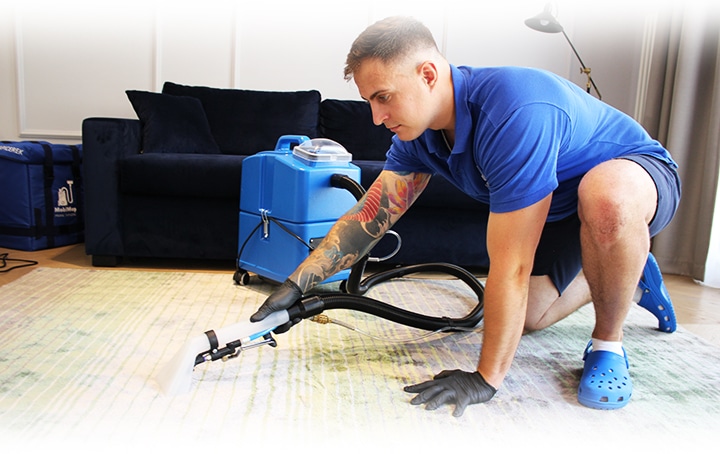
A rug looks clean for far longer than it actually is clean. Dust, pet hair, mites and airborne grease work their way down into the pile, where a vacuum cleaner can no longer reach them. Below you will find straight answers: how often to clean a rug at home, in a household with an allergy sufferer and in an office, how to tell that the time has come, how long the job takes and how long a rug takes to dry afterwards.
How often to clean a rug - the short answer
In a typical home without pets, hot-water extraction once a year is enough. If there are animals, small children or someone with allergies in the house, the interval shortens to six months. In offices, consulting rooms and commercial premises where dozens of people pass through daily, rugs and carpets are cleaned every three to six months.
That is a starting point, not a rigid rule. The real interval depends on four things: how many people live there, whether there are pets, whether shoes are worn indoors, and how much light and moisture the room gets. A rug in a bedroom shared by two adults can comfortably last a year. The same rug in a living room with a dog and two children will need cleaning after six months.
Recommended intervals by situation
The table below gathers the intervals that work in practice. These are figures for extraction cleaning, where the solution is injected into the pile and immediately drawn back out along with the dirt.
| Situation | How often | Why |
|---|---|---|
| House or flat without pets | Once a year | Dirt builds up slowly; regular vacuuming between cleans is enough |
| Household with pets | Every 6 months | Hair and skin oils bind dust and lock odour into the fibre |
| Household with an allergy sufferer | Every 4 to 6 months | Mites feed on shed skin cells that collect in the pile |
| Children's room | Every 6 months | Food and drink stains appear regularly and a child is in close contact with the floor |
| Office, waiting room, surgery | Every 3 to 6 months | Heavy traffic, street shoes, grit that acts like sandpaper |
| Short-term rental | After every longer stay | You never know what happened on the rug - what counts is the state at handover |
How to tell a rug needs cleaning
You do not have to watch the calendar. The rug tells you itself; you only need to know what to look for.
Signs that are not obvious at first glance
- The colour has lost its depth. Compare a patch under the sofa or a table leg with the area you walk on. A clear difference is not worn fibre, it is a layer of dirt.
- The pile has stopped springing back. A soiled rug feels harder; the fibres stick together with grease and no longer stand upright.
- The smell returns a few hours after airing. That means the source of the odour is inside the rug rather than in the air.
- The vacuum picks up less and less. It sounds paradoxical, but it means the dirt has moved deeper and the vacuum no longer reaches it.
- Skin and airways react. Sneezing and irritation in the morning, after a night in a room with a rug, is a classic sign of dust mites.
The palm test and the tissue test
Two ways to check the state of a rug in a minute. First: run an open palm firmly across the pile against the nap. If a greyish film stays on your hand, the dirt is already in the structure. Second: lay a white tissue down and press it with your foot or knee for fifteen seconds or so. A mark on the tissue means the rug holds moisture with dirt in it, not just dust.
What extraction does that vacuuming cannot
Vacuuming and washing are two different operations and do not replace one another. A vacuum works on the surface: it removes dust, crumbs and some hair. Extraction works deep in the pile.
In extraction cleaning the machine injects a solution of water and cleaning agent into the rug under pressure and, at the same moment, draws it back out together with the dissolved dirt. That is how the invisible things come out: grease from kitchen air, residue of detergents from previous cleaning attempts, mite droppings, skin particles and hair woven into the weave.
The difference is clearest in the colour of the water in the recovery tank. Even a rug that looks respectable can produce water the colour of strong tea, and that is after regular vacuuming.
We check the fibre type, the density of the pile and how fast the dyes are. Wool, viscose and art silk need different products and a different amount of water than polyester or polypropylene.
We collect dry soil and hair. This stage decides the result - wet grit spread through the pile only makes the work harder.
Coffee, wine, grease and urine stains are treated separately with the appropriate product before the whole rug gets wet.
The solution enters the pile and is drawn out immediately. We go over the rug several times, with the final passes made without adding water - that shortens the drying.
We balance the pH so no residue is left on the fibres to attract dirt, then comb the pile in one direction.
How long a rug takes to dry
At home, at room temperature with a window ajar, a synthetic rug usually dries in four to six hours. Thick pile, wool and rugs with a dense backing need eight to twelve hours. In summer, with windows open, it can be quicker; in winter with the windows shut and high humidity, slower.
Drying time depends above all on how much water is left in the rug after cleaning. Equipment with strong suction (high waterlift) removes far more water than a domestic wet vacuum, which is why the difference in drying can run to a dozen hours or more.
How to speed up drying
- Get the air moving - a window ajar plus a fan aimed along the rug works better than heating alone.
- Do not put furniture back on a damp rug. Metal feet can leave marks, wooden ones can leave discolouration.
- Do not cover the rug with a blanket or plastic sheet - the moisture has nowhere to go.
- If the room is very humid, use a dehumidifier rather than a radiator. Warm, humid air dries more slowly than cool, dry air.
The most common mistakes when cleaning it yourself
Most of the damaged rugs that reach us after home attempts have one of five problems.
Too much water
The rug soaks through, the water reaches the backing and stays there. The result: the rug takes two days to dry, and once dry there is a musty smell, sometimes distortion and yellowing at the edge of the wet area.
Too much product
Excess detergent cannot be rinsed out and stays on the fibres. Such a rug gets dirty faster than it did before cleaning, because the detergent residue attracts dust. This is the commonest reason for "the rug got dirty two weeks after cleaning".
Scrubbing the stain
Rubbing spreads the stain over a larger area and damages the fibres mechanically - that spot stays matt for good. Stains are lifted by pressing and blotting, not by rubbing.
The wrong product for the fibre
High-pH products deal with grease beautifully but strip the colour from wool and silk. The reverse is also true: a gentle wool product will not touch greasy soiling on polypropylene. Without identifying the fibre, an irreversible mistake is easy.
Drying in the sun
Direct sunlight dries quickly but also bleaches. Wool additionally goes hard. A rug should dry in the shade, with air moving through.
Cleaning a rug and the type of fibre
How often a rug can be cleaned, and with what, depends on the material. Below are the cases we meet most often in Polish homes.
- Polypropylene (BCF) - the most common and the most forgiving. Resistant to water and most products, it takes extraction well.
- Polyester - soft, holds colour well, but absorbs grease. It needs grease-dissolving products, not water alone.
- Wool - natural and durable, but sensitive to high pH and high temperature. It is cleaned cooler, with a gentler product and less water.
- Viscose and art silk - the hardest of all. The fibre loses its strength when wet and permanent water marks are easy to create. Extraction is often inadvisable here; low-moisture methods are used instead.
- Long-pile shaggy - needs more passes and longer drying, because water sits at the base of the tuft.
What rug cleaning costs and what affects the price
The price is usually calculated per square metre, and the rate depends on the type of pile and the state of the rug. Surcharges appear for long-pile rugs, heavy pet soiling and urine odour removal, because that calls for enzyme products and longer working time. Current rates are in our price list, and if you want a quote for your own rug, a photo and the dimensions are enough.
It is worth comparing the cost of cleaning with the cost of replacement. Cleaning a rug costs a fraction of a new one, and done once a year it adds several years to its life. A rug that has never been cleaned is usually beyond refreshing after five or six years - the grit cuts through the fibres from the inside.
Cleaning at your home or taking the rug away
We clean rugs on site, at the customer's home. The equipment arrives complete, the rug stays where it lies, and you do not have to roll it up, transport it or wait several days to get it back. For a typical 3x4 m rug the whole process takes forty to seventy minutes including spot treatment.
Taking a rug away to a plant makes sense in only two cases: valuable hand-woven wool rugs, and flooded rugs that need rinsing in a bath. In all other situations, cleaning at your home gives the same result without a week with no rug in the house.
How to look after a rug between cleans
Cleaning once a year is only enough if the rug gets a minimum of attention during the other twelve months. A few habits genuinely extend the intervals and reduce the risk of permanent stains.
Vacuuming that actually works
Once a week for one person, twice for a family, every other day with pets. Technique matters more than frequency: move the vacuum slowly and make several passes in different directions. One quick pass picks up only part of the dust, because the fibres do not have time to open.
Doormats and the entrance zone
Around 80% of dirt enters a home on shoes. A good mat outside the door and a second one in the hallway stop most of the grit before it reaches the rug in the living room. It is the cheapest way to extend a rug's life.
Reacting to a fresh stain
There is one rule: lift the excess, do not rub it in. Take up the liquid with a white paper towel, pressing and holding, working from the outside of the stain inwards. A fresh coffee or juice stain comes out in minutes; the same stain a week later can stay for good, because the pigment has bound to the fibre. We covered this in more detail in our pieces on coffee stains and wine stains.
Turning and airing
Every few months, turn the rug through 180 degrees so the traffic spreads evenly and the pile does not wear down in a single strip. Once a season it is also worth taking a smaller rug out onto the balcony for a few hours in the shade; moving air removes the moisture that dust mites like best.
Rugs and fitted carpet - are the rules the same
The principle of frequency is similar, but fitted carpet differs in two ways that change how the work is done. First, it is glued down, so it cannot be lifted or dried from underneath, which makes precise water dosing critical. Second, it covers the whole floor area, so it collects incomparably more grit at doorways and under desks.
In offices, carpet in circulation routes soils several times faster than carpet under desks. That is why we usually propose a mixed plan: a full clean of the whole area every six months and a clean of the traffic lanes alone every quarter. It works out cheaper than cleaning everything four times a year, and the visual result is the same. Details are in the description of office carpet cleaning.
Frequently asked questions
Does cleaning damage the fibres?
Done properly, no. What damages them is grit, which cuts through the fibres from within as people walk, and overly aggressive products. Regular cleaning removes the grit and extends the rug's life.
Can a rug be cleaned in winter?
Yes. A heated room dries well; you only need to keep the air changing - a few minutes of airing every hour is enough.
How often should I clean the rug if I have a dog or a cat?
About every six months, and for animals that go outdoors, as often as every four. Hair binds dust, and the oils from an animal's skin lock odour into the pile.
Will cleaning remove pet odour?
Ordinary hair odour, yes. Urine odour needs a separate treatment with an enzyme product, because the source is uric acid crystals that have to be broken down rather than simply rinsed away.
Does furniture have to be moved out?
No. Moving light items aside is enough; with heavy furniture we clean the accessible areas, and under furniture a rug soils incomparably more slowly anyway.
When can we walk on the rug again?
Barefoot or in clean socks after about three to four hours; furniture goes back once it is fully dry, which usually means the next day.
In summary
Once a year in a home without pets, every six months with animals and children, every three to six months in an office - that is the rhythm that keeps a rug in good condition and stops dirt getting too deep. Between cleans, vacuuming and a quick response to stains are enough: the sooner you deal with a fresh stain, the smaller the chance it stays for good.
If you are not sure whether your rug needs cleaning yet, send us a photo - we will assess it and give you a price before we arrive. Take a look too at rug cleaning at your address and at upholstery cleaning if you want to freshen up the sofa along with the rug.